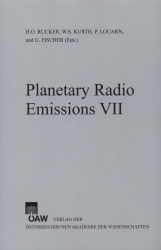
• H.O. Rucker - W.S. Kurth - P. Louarn - G. Fischer (Eds.)

Planetary Radio Emissions VII

Proceedings of the 7th International Workshop on Planetary, Solar and Heliospheric Radio Emissions held at Graz, Austria, September 15–17, 2010

Bild

Helmut Rucker
Space Research Institute, Austrian Academy of Sciences, Graz, Austria

William Kurth
Department of Physics and Astronomy, University of Iowa, Iowa City, USA

Philippe Louarn
Centre d'Etude Spatiale de Rayonnements, CNRS/Universitè Paul-Sabatier Toulouse III, Toulouse, France

Georg Fischer
Space Research Institute, Austrian Academy of Sciences, Graz, Austria


ISBN 978-3-7001-7125-6 Print Edition
ISBN 978-3-7001-7246-8 Online Edition

doi: https://doi.org/10.1553/PRE7

2011  578 Seiten, 23x15cm, broschiert
€  79,–   

The 7th International Workshop on "Planetary, Solar and Heliospheric Radio Emissions" is the continuation of an established tradition: This PRE VII conference followed previous successful international workshops held at Graz, Austria, in 1984, 1987, 1991, 1996, 2001, and 2005. This 7th workshop in September 2010 offered again the unique opportunity to discuss the observations from Cassini at Saturn and to investigate the measurements by other spacecraft and from the ground of the Jovian, terrestrial and solar radio emissions, also including studies on radiation from exoplanetary sources.

Verlag der Österreichischen Akademie der Wissenschaften
Austrian Academy of Sciences Press
A-1011 Wien, Dr. Ignaz Seipel-Platz 2
Tel. +43-1-515 81/DW 3420, Fax +43-1-515 81/DW 3400
https://verlag.oeaw.ac.at, e-mail: verlag@oeaw.ac.at

Bestellung/Order


Bild
Planetary Radio Emissions VII


ISBN 978-3-7001-7125-6
Print Edition
ISBN 978-3-7001-7246-8
Online Edition


Send or fax to your local bookseller or to:

Verlag der Österreichischen Akademie der Wissenschaften
Austrian Academy of Sciences Press
A-1011 Wien, Dr. Ignaz Seipel-Platz 2,
Tel. +43-1-515 81/DW 3420, Fax +43-1-515 81/DW 3400
https://verlag.oeaw.ac.at, e-mail: bestellung.verlag@oeaw.ac.at
UID-Nr.: ATU 16251605, FN 71839x Handelsgericht Wien, DVR: 0096385

Bitte senden Sie mir
Please send me
 
Exemplar(e) der genannten Publikation
copy(ies) of the publication overleaf


NAME


ADRESSE / ADDRESS


ORT / CITY


LAND / COUNTRY


ZAHLUNGSMETHODE / METHOD OF PAYMENT
    Visa     Euro / Master     American Express


NUMMER

Ablaufdatum / Expiry date:  

    I will send a cheque           Vorausrechnung / Send me a proforma invoice
 
DATUM, UNTERSCHRIFT / DATE, SIGNATURE

BANK AUSTRIA CREDITANSTALT, WIEN (IBAN AT04 1100 0006 2280 0100, BIC BKAUATWW), DEUTSCHE BANK MÜNCHEN (IBAN DE16 7007 0024 0238 8270 00, BIC DEUTDEDBMUC)
Bild

Variability of Southern and Northern SKR Periodicities

    L. Lamy

Planetary Radio Emissions VII, pp. 39-50, 2011/12/28

Proceedings of the 7th International Workshop on Planetary, Solar and Heliospheric Radio Emissions held at Graz, Austria, September 15–17, 2010

doi: 10.1553/PRE7s39

€  79,– 

incl. VAT

PDF
X
BibTEX-Export:

X
EndNote/Zotero-Export:

X
RIS-Export:

X 
Researchgate-Export (COinS)

Permanent QR-Code

doi:10.1553/PRE7s39


Abstract

Among the persistent questions raised by the existence of a rotational modulation of the Saturn Kilometric Radiation (SKR), the origin of the variability of the 10.8 hours SKR period at a 1% level over weeks to years remains intriguing. While its short-term fluctuations (20-30 days) have been related to the variations of the solar wind speed, its long-term fluctuations (months to years) were proposed to be triggered by Enceladus mass-loading and/or seasonal variations. This situation has become even more complicated since the recent identification of two separated periods at 10.8h and 10.6h, each varying with time, corresponding to SKR sources located in the southern (S) and the northern (N) hemispheres, respectively. Here, six years of Cassini continuous radio measurements are investigated, from 2004 (preequinox) to the end of 2010 (post-equinox). From S and N SKR, radio periods and phase systems are derived separately for each hemisphere and fluctuations of radio periods are investigated at time scales of years to a few months. Then, the S phase is used to demonstrate that the S SKR rotational modulation is consistent with an intrinsically rotating phenomenon, in contrast with the early Voyager picture.