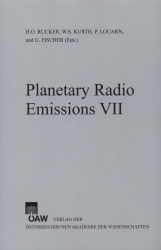
• H.O. Rucker - W.S. Kurth - P. Louarn - G. Fischer (Eds.)

Planetary Radio Emissions VII

Proceedings of the 7th International Workshop on Planetary, Solar and Heliospheric Radio Emissions held at Graz, Austria, September 15–17, 2010

Bild

Helmut Rucker
Space Research Institute, Austrian Academy of Sciences, Graz, Austria

William Kurth
Department of Physics and Astronomy, University of Iowa, Iowa City, USA

Philippe Louarn
Centre d'Etude Spatiale de Rayonnements, CNRS/Universitè Paul-Sabatier Toulouse III, Toulouse, France

Georg Fischer
Space Research Institute, Austrian Academy of Sciences, Graz, Austria


ISBN 978-3-7001-7125-6 Print Edition
ISBN 978-3-7001-7246-8 Online Edition

doi: https://doi.org/10.1553/PRE7

2011  578 Seiten, 23x15cm, broschiert
€  79,–   

The 7th International Workshop on "Planetary, Solar and Heliospheric Radio Emissions" is the continuation of an established tradition: This PRE VII conference followed previous successful international workshops held at Graz, Austria, in 1984, 1987, 1991, 1996, 2001, and 2005. This 7th workshop in September 2010 offered again the unique opportunity to discuss the observations from Cassini at Saturn and to investigate the measurements by other spacecraft and from the ground of the Jovian, terrestrial and solar radio emissions, also including studies on radiation from exoplanetary sources.

Verlag der Österreichischen Akademie der Wissenschaften
Austrian Academy of Sciences Press
A-1011 Wien, Dr. Ignaz Seipel-Platz 2
Tel. +43-1-515 81/DW 3420, Fax +43-1-515 81/DW 3400
https://verlag.oeaw.ac.at, e-mail: verlag@oeaw.ac.at

Bestellung/Order


Bild
Planetary Radio Emissions VII


ISBN 978-3-7001-7125-6
Print Edition
ISBN 978-3-7001-7246-8
Online Edition


Send or fax to your local bookseller or to:

Verlag der Österreichischen Akademie der Wissenschaften
Austrian Academy of Sciences Press
A-1011 Wien, Dr. Ignaz Seipel-Platz 2,
Tel. +43-1-515 81/DW 3420, Fax +43-1-515 81/DW 3400
https://verlag.oeaw.ac.at, e-mail: bestellung.verlag@oeaw.ac.at
UID-Nr.: ATU 16251605, FN 71839x Handelsgericht Wien, DVR: 0096385

Bitte senden Sie mir
Please send me
 
Exemplar(e) der genannten Publikation
copy(ies) of the publication overleaf


NAME


ADRESSE / ADDRESS


ORT / CITY


LAND / COUNTRY


ZAHLUNGSMETHODE / METHOD OF PAYMENT
    Visa     Euro / Master     American Express


NUMMER

Ablaufdatum / Expiry date:  

    I will send a cheque           Vorausrechnung / Send me a proforma invoice
 
DATUM, UNTERSCHRIFT / DATE, SIGNATURE

BANK AUSTRIA CREDITANSTALT, WIEN (IBAN AT04 1100 0006 2280 0100, BIC BKAUATWW), DEUTSCHE BANK MÜNCHEN (IBAN DE16 7007 0024 0238 8270 00, BIC DEUTDEDBMUC)
Bild

Beaming Cone of Io-Controlled Jovian Decameter Radio Emission and Existence of Localized Active Longitude

    P. H. M. Galopeau, M. Y. Boudjada

Planetary Radio Emissions VII, pp. 197-204, 2011/12/28

Proceedings of the 7th International Workshop on Planetary, Solar and Heliospheric Radio Emissions held at Graz, Austria, September 15–17, 2010

doi: 10.1553/PRE7s197

€  79,– 

incl. VAT

PDF
X
BibTEX-Export:

X
EndNote/Zotero-Export:

X
RIS-Export:

X 
Researchgate-Export (COinS)

Permanent QR-Code

doi:10.1553/PRE7s197


Abstract

The occurrence probability of the Jovian decameter radio emissions depends on two essential parameters: the central meridian longitude (CML) and the orbital phase of the satellite Io. Four main zones of enhanced occurrence probability emerge from the CML-Io phase diagram: the so-called Io-controlled sources Io-A, Io-B, Io-C and Io-D. We study the compatibility of the location of these sources with the existence of a specific active longitude range, anchored in Jupiter’s magnetic field, and favoring the radio emissions. A theoretical model, based on the cyclotron maser instability (CMI), was proposed a few years ago in order to explain the existence of such active longitudes, assuming that the radiation was emitted at the local gyrofrequency in a hollow cone of constant angle, along a magnetic field line carried away by Io through its revolution around Jupiter. Unfortunately this model was not able to justify the dimension in longitude of all the Io-controlled sources, in particular those located in the Jovian southern hemisphere (Io-C and Io-D). We show that the azimuthal distribution of the four occurrence regions (Io-A, Io-B, Io-C and Io-D) around the gradient of the local magnetic field is not constant so that the emission cone (in each Jovian hemisphere) presents a significant flattening in the direction of the magnetic field vector. Introducing a beaming cone with an elliptical section makes the location and extension in longitude of the sources (in the CML-Io phase diagram) compatible with the existence of an active longitude. A theory of the CMI, acting in an inhomogeneous medium in which the magnetic field vector and the gradient of its modulus are not aligned, shall be required in order to justify the flattening of the emission cone.