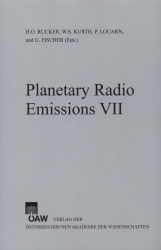
• H.O. Rucker - W.S. Kurth - P. Louarn - G. Fischer (Eds.)

Planetary Radio Emissions VII

Proceedings of the 7th International Workshop on Planetary, Solar and Heliospheric Radio Emissions held at Graz, Austria, September 15–17, 2010

Bild

Helmut Rucker
Space Research Institute, Austrian Academy of Sciences, Graz, Austria

William Kurth
Department of Physics and Astronomy, University of Iowa, Iowa City, USA

Philippe Louarn
Centre d'Etude Spatiale de Rayonnements, CNRS/Universitè Paul-Sabatier Toulouse III, Toulouse, France

Georg Fischer
Space Research Institute, Austrian Academy of Sciences, Graz, Austria


ISBN 978-3-7001-7125-6 Print Edition
ISBN 978-3-7001-7246-8 Online Edition

doi: https://doi.org/10.1553/PRE7

2011  578 Seiten, 23x15cm, broschiert
€  79,–   

The 7th International Workshop on "Planetary, Solar and Heliospheric Radio Emissions" is the continuation of an established tradition: This PRE VII conference followed previous successful international workshops held at Graz, Austria, in 1984, 1987, 1991, 1996, 2001, and 2005. This 7th workshop in September 2010 offered again the unique opportunity to discuss the observations from Cassini at Saturn and to investigate the measurements by other spacecraft and from the ground of the Jovian, terrestrial and solar radio emissions, also including studies on radiation from exoplanetary sources.

Verlag der Österreichischen Akademie der Wissenschaften
Austrian Academy of Sciences Press
A-1011 Wien, Dr. Ignaz Seipel-Platz 2
Tel. +43-1-515 81/DW 3420, Fax +43-1-515 81/DW 3400
https://verlag.oeaw.ac.at, e-mail: verlag@oeaw.ac.at

Bestellung/Order


Bild
Planetary Radio Emissions VII


ISBN 978-3-7001-7125-6
Print Edition
ISBN 978-3-7001-7246-8
Online Edition


Send or fax to your local bookseller or to:

Verlag der Österreichischen Akademie der Wissenschaften
Austrian Academy of Sciences Press
A-1011 Wien, Dr. Ignaz Seipel-Platz 2,
Tel. +43-1-515 81/DW 3420, Fax +43-1-515 81/DW 3400
https://verlag.oeaw.ac.at, e-mail: bestellung.verlag@oeaw.ac.at
UID-Nr.: ATU 16251605, FN 71839x Handelsgericht Wien, DVR: 0096385

Bitte senden Sie mir
Please send me
 
Exemplar(e) der genannten Publikation
copy(ies) of the publication overleaf


NAME


ADRESSE / ADDRESS


ORT / CITY


LAND / COUNTRY


ZAHLUNGSMETHODE / METHOD OF PAYMENT
    Visa     Euro / Master     American Express


NUMMER

Ablaufdatum / Expiry date:  

    I will send a cheque           Vorausrechnung / Send me a proforma invoice
 
DATUM, UNTERSCHRIFT / DATE, SIGNATURE

BANK AUSTRIA CREDITANSTALT, WIEN (IBAN AT04 1100 0006 2280 0100, BIC BKAUATWW), DEUTSCHE BANK MÜNCHEN (IBAN DE16 7007 0024 0238 8270 00, BIC DEUTDEDBMUC)
Bild

AKR Diurnal, Semi-Diurnal and Shorter Term Modulations Disentangled by Cassini/RPWS Observations (abstract)

    L. Lamy, P. Zarka, R. Prangé

Planetary Radio Emissions VII, pp. 283-284, 2011/12/28

Proceedings of the 7th International Workshop on Planetary, Solar and Heliospheric Radio Emissions held at Graz, Austria, September 15–17, 2010

doi: 10.1553/PRE7s283

€  79,– 

incl. VAT

PDF
X
BibTEX-Export:

X
EndNote/Zotero-Export:

X
RIS-Export:

X 
Researchgate-Export (COinS)

Permanent QR-Code

doi:10.1553/PRE7s283


Abstract

During the flyby of the Earth by Cassini in 1999, the Radio and Plasma Wave Science (RPWS) instrument recorded one month of quasi-continuous observations of Auroral Kilometric Radiation (AKR). Analyzing the Stokes parameters of incoming radio waves, we found AKR to be 100% circular left-handed (LH) or right-handed (RHW). We analyzed separately the northern - RH - emission, from the southern - LH - one with respect to the magnetic equator. AKR power variations reveal (i) a log-normal distribution at time scales of minutes, (ii) bursts of emission at time scales of a few hours, and (iii) a clear modulation at 24 hours, with a weaker modulation at 12 hours (especially visible for LH emissions). The prominent 24 h modulation is found to modulate LH and RH AKR in phase opposition. This is interpreted as being due to visibility effects related to the precession of the terrestrial magnetic dipole, making Cassini oscillate relative to the average AKR beaming pattern from each hemisphere. We accordingly quantified the AKR beaming vs explored latitudes. On time scales shorter than a few hours, LH and RH emissions are found to be correlated. This is attributed to the actual conjugacy of the corresponding sources, simultaneously turned on by substorm occurrence. The geometrical anti-correlation (at 24 h) dominates close to Earth, while the short term correlation (substorms) dominates far from Earth, where the detection threshold makes the visibility less important than the occurrence of substorms. Finally, the 12 h modulation is detected when it is not masked by strong visibility effects, i.e. for the LH emission which is observed mostly near the magnetic equator along the path of Cassini. A 12 h modulation being also observed in some geomagnetic indices, we suggest that a physical process (e.g. semi-diurnal variable efficiency of the reconnection between interplanetary and geomagnetic fields, or magnetotail oscillations) may be responsible of the observed AKR 12 h modulation.