Georg FISCHER
is a researcher at the Space Research Institute of the Austrian Academy of Sciences
Gottfried MANN
is a staff scientist in the Physics of the Sun Section at the Leibniz-Institut für Astrophysik Potsdam
Mykhaylo PANCHENKO
is a research scientist at the Space Research Institute of the Austrian Academy of Sciences in Graz
Philippe ZARKA
is Director of Research at the French National Center for Scientific Research
|
 |
ISBN 978-3-7001-8263-4 Print Edition
ISBN 978-3-7001-8392-1 Online Edition
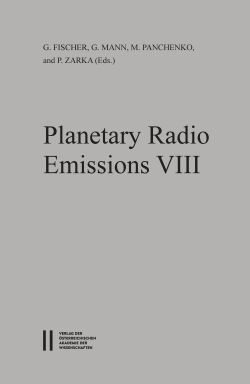
The “8th International Workshop on Planetary, Solar and Heliospheric Radio Emissions” was held in October 2016 in the historical castle Schloss Seggau, about 35 km south of Graz, Austria. The proceedings of this workshop are now available as the book Planetary Radio Emissions VIII (PRE VIII), which is a continuation of the “PRE silver series” issued by the Austrian Academy of Sciences Press. All contributions were peer-reviewed under the guidance of the four editors.
For more than three decades the developments in the field of planetary and solar radio emissions have been documented in the PRE proceedings. The new volume PRE VIII contains articles about the first observations from the Juno spacecraft, which started to orbit Jupiter in mid-2016, and articles analysing the data of Cassini, whose mission ended in September 2017. A large number of contributions deals with the topic of Jovian radio emissions, where the ground-based support of space missions has become increasingly important, and where the statistical analysis of years of data have led to new conclusions about the influence of the Galilean moons. The large ground-based radio telescopes (LOFAR, UTR-2, GURT, LWA, NDA and others) have other important scientific targets besides Jupiter, namely the Sun and exoplanets. The articles about exoplanets in PRE VIII give the impression that a first detection of radio emission signatures could happen in a not too distant future. Other contributions deal with terrestrial radio emissions and theory. Finally, the technical developments in instrumentation have led to the discovery of new fine structures in radio emissions or to improved solar radio imaging, and newly developed databases should make radio data available to all interested scientists around the globe.
…
Der achte internationale Workshop über planetare, solare und heliosphärische Radiostrahlung wurde im Oktober 2016 im historischen Schloss Seggau, ca. 35 km südlich von Graz, abgehalten. Die gesammelten Beiträge des Workshops erscheinen nun als Buch mit dem Titel „Planetary Radio Emissions VIII“ (PRE VIII), welches eine Fortsetzung der „silbernen Reihe“ PRE I–VII darstellt. Alle schriftlichen Beiträge wurden einem Begutachtungsverfahren unterworfen, das von den vier Herausgebern geleitet wurde.
Die Entwicklungen im Bereich der planetaren und solaren Radiostrahlung werden bereits seit mehr als drei Jahrzehnten in den PRE-Sammelbänden dokumentiert. Der neue Band PRE VIII enthält Artikel über die ersten Messungen der Raumsonde Juno, die seit Mitte 2016 den Jupiter umkreist, und Artikel, in denen die Daten der Raumsonde Cassini, deren Mission im September 2017 endete, analysiert werden. Eine große Anzahl an Beiträgen gibt es zum Thema der Radiostrahlung von Jupiter: Hier wird die Unterstützung von Satellitenmissionen durch bodengebundene Radioteleskope immer wichtiger, und neue statistische Analysen von großen Datenmengen haben zu neuen Erkenntnissen über den Einfluss der Galileischen Monde auf die Jupiterradiostrahlung geführt. Neben Jupiter gibt es für die großen Radioteleskope auf der Erde (LOFAR, UTR-2, GURT, LWA, NDA u. a.) noch weitere Schwerpunkte, besonders die Sonne und Exoplaneten. Die Artikel zu den Exoplaneten in PRE VIII hinterlassen den Eindruck, dass die erste Entdeckung von Radioemissionen von Exoplaneten nicht mehr lange auf sich warten lassen wird. Weiters gibt es Beiträge zu terrestrischen Radioemissionen und zur Theorie der Radiostrahlung. Die technischen Entwicklungen bei den Instrumenten haben zur Entdeckung von neuen Feinstrukturen in den Emissionen und zu einer verbesserten Lokalisierung von Radioquellen auf der Sonne geführt, und neu entwickelte Datenbanken sollen Radiodaten für alle daran interessierten Wissenschaftler verfügbar machen.
|