![]() |
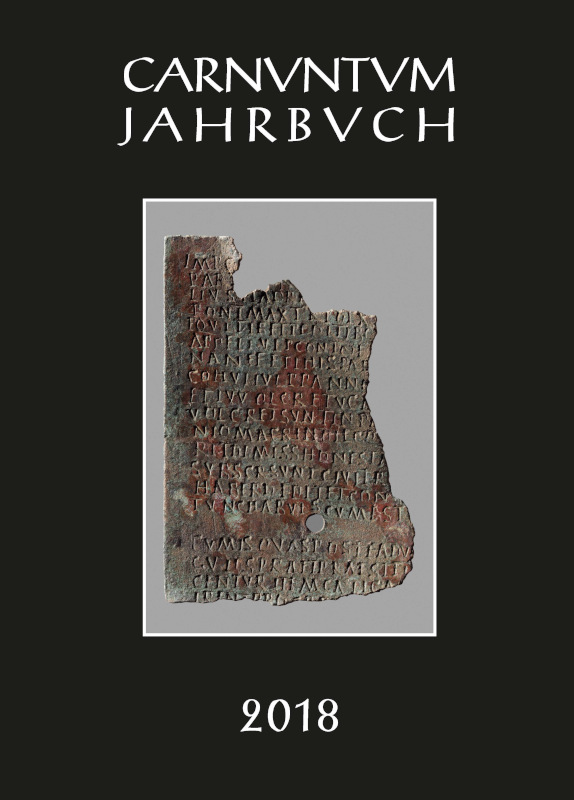
Carnuntum Jahrbuch 2018Zeitschrift für Archäologie und Kulturgeschichte des Donauraumes
|
![]() |
Verlag der Österreichischen Akademie der Wissenschaften Austrian Academy of Sciences Press
A-1011 Wien, Dr. Ignaz Seipel-Platz 2
Tel. +43-1-515 81/DW 3420, Fax +43-1-515 81/DW 3400 https://verlag.oeaw.ac.at, e-mail: verlag@oeaw.ac.at |
|
||||||||||||||||||||
|
DATUM, UNTERSCHRIFT / DATE, SIGNATURE
BANK AUSTRIA CREDITANSTALT, WIEN (IBAN AT04 1100 0006 2280 0100, BIC BKAUATWW), DEUTSCHE BANK MÜNCHEN (IBAN DE16 7007 0024 0238 8270 00, BIC DEUTDEDBMUC)
|

Carnuntum Jahrbuch 2018, pp. 47-85, 2019/12/02
Zeitschrift für Archäologie und Kulturgeschichte des Donauraumes
Between 2012 and 2017, geophysical measurements and field surveys provide for the first time detailed insights into the structure and development of the western suburbium of the civilian city of Carnuntum. The western suburbs are dominated by strip houses, while more complex residential buildings can be found towards the city centre. Furthermore it was possible to locate an isolated villa suburbana out of town. At the edge of the settlement north of the so-called Limesstraße, a potential sanctuary is integrated into the strip house architecture. There is also evidence of a temporary Roman military camp with estimated dimensions of 5–7 ha, which precedes the roadside village. This ribbon-built village was probably estab- lished in the course of the 2 nd century due to road relo- cations. It existed until the middle of the 3rd century and was then abandoned in the second half of the century. Thus parallels to other desertification pro- cesses can be made, which point to demographic changes in Carnuntum during the advanced 3 rd cen- tury.