• Andreas Pülz (Schriftleitung)

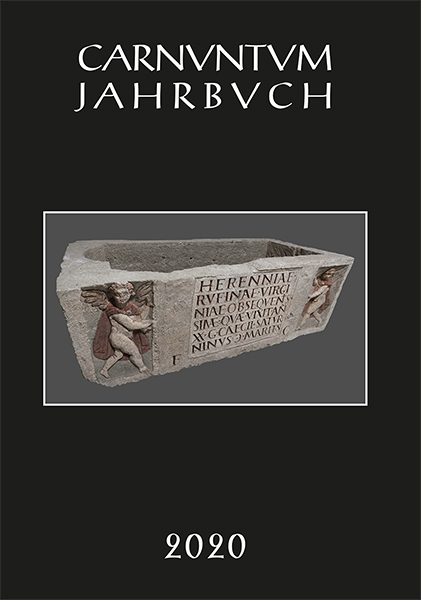
Carnuntum Jahrbuch 2020

Zeitschrift für Archäologie und Kulturgeschichte des Donauraumes

Bild


Beiträge

Andreas Konecny – Franz Humer – Silvia Radbauer – Christian Gugl – Roman Igl – Nicole Fuchshuber
Zwei Infrastruktureinrichtungen des römischen Carnuntum: der Aquädukt in der Flur Gstettenbreite und die Limesstraße

Christian Gugl – Silvia Radbauer – Mario Wallner – Franz Humer – Eduard Pollhammer – Wolfgang Neubauer
Vor den Toren der Stadt – Struktur und Entwicklung des westlichen Suburbiums der Carnuntiner Zivilstadt. Neubewertung der Notgrabung 1976 aufgrund der geophysikalischen Messungen 2012–2015

Christian Gugl – Silvia Radbauer – Ingeborg Gaisbauer – Mario Wallner
Mittelalterliche und frühneuzeitliche Befunde und Funde von der Flur Gstettenbreite: Evidenz für nachantike Siedlungstätigkeiten am westlichen Ortsrand von Petronell-Carnuntum

Ausgrabungen und Funde

Izida Berger-Pavić
Italische grautonige dünnwandige Keramik (pareti sottili) aus Carnuntum
Mit chemischen Analysen (Röntgenfluoreszenzanalysen), durchgeführt von Małgorzata Daszkiewicz und Gerwulf Schneider

Franziska Beutler – Gabrielle Kremer
Eine Aschenkiste und zwei Sarkophage mit Grabinschriften aus dem Gräberfeld südlich der Zivilstadt von Carnuntum
Mit Beiträgen von Karl Großschmidt, Robert Linke und Andreas Rohatsch mit Beatrix Moshammer

Tafeln

Verlag der Österreichischen Akademie der Wissenschaften
Austrian Academy of Sciences Press
A-1011 Wien, Dr. Ignaz Seipel-Platz 2
Tel. +43-1-515 81/DW 3420, Fax +43-1-515 81/DW 3400
https://verlag.oeaw.ac.at, e-mail: verlag@oeaw.ac.at

Bestellung/Order


Bild
Carnuntum Jahrbuch 2020
ISSN 1025-2320
Print Edition
ISSN 2518-3176
Online Edition
ISBN 978-3-7001-8998-5
Print Edition
ISBN 978-3-7001-9002-8
Online Edition


Send or fax to your local bookseller or to:

Verlag der Österreichischen Akademie der Wissenschaften
Austrian Academy of Sciences Press
A-1011 Wien, Dr. Ignaz Seipel-Platz 2,
Tel. +43-1-515 81/DW 3420, Fax +43-1-515 81/DW 3400
https://verlag.oeaw.ac.at, e-mail: bestellung.verlag@oeaw.ac.at
UID-Nr.: ATU 16251605, FN 71839x Handelsgericht Wien, DVR: 0096385

Bitte senden Sie mir
Please send me
 
Exemplar(e) der genannten Publikation
copy(ies) of the publication overleaf


NAME


ADRESSE / ADDRESS


ORT / CITY


LAND / COUNTRY


ZAHLUNGSMETHODE / METHOD OF PAYMENT
    Visa     Euro / Master     American Express


NUMMER

Ablaufdatum / Expiry date:  

    I will send a cheque           Vorausrechnung / Send me a proforma invoice
 
DATUM, UNTERSCHRIFT / DATE, SIGNATURE

BANK AUSTRIA CREDITANSTALT, WIEN (IBAN AT04 1100 0006 2280 0100, BIC BKAUATWW), DEUTSCHE BANK MÜNCHEN (IBAN DE16 7007 0024 0238 8270 00, BIC DEUTDEDBMUC)
Bild

Vor den Toren der Stadt – Struktur und Entwicklung des westlichen Suburbiums der Carnuntiner Zivilstadt. Neubewertung der Notgrabung 1976 aufgrund der geophysikalischen Messungen 2012–2015

    Christian Gugl, Silvia Radbauer, Mario Wallner, Franz Humer, Eduard Pollhammer, Wolfgang Neubauer

Carnuntum Jahrbuch 2020, pp. 37-84, 2021/12/21

Zeitschrift für Archäologie und Kulturgeschichte des Donauraumes

doi: 10.1553/cjb_2020s37


Autor(en):
Titel:
GoID:
Preis:
ISBN13:

doi: 10.1553/cjb_2020s37

PDF
X
BibTEX-Export:

X
EndNote/Zotero-Export:

X
RIS-Export:

X 
Researchgate-Export (COinS)

Permanent QR-Code

doi:10.1553/cjb_2020s37


doi:10.1553/cjb_2020s37

Abstract

This third contribution to the research on the western edge of the Roman city of Carnuntum focuses on two aspects. First, the geophysical measurements, in particular the ground penetrating radar surveys of the years 2012–2015, are evaluated in detail, focusing on the overall architectural structure of the western suburb, but also on the individual building types represented in the area. The geophysical measurement data are contrasted with the results of a rescue excavation that was carried out directly north of the prospected areas as early as 1976. The finds from these excavations, including graves from the end of the 3rd century or from the time around 300 AD, are presented here for the first time. This also allows the basic chronological framework of the western suburb, which was developed in the two previously published articles, to be further consolidated.