|
 |
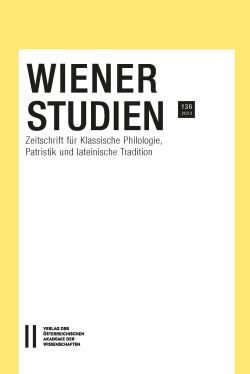
Die „Wiener Studien“, gegründet 1879, sind eine internationale wissenschaftliche Zeitschrift für Klassische Philologie, Patristik und lateinische Tradition. Sie erscheinen jährlich, unterliegen einem Peer-Review-Verfahren und werden vom Institut für Klassische Philologie, Mittel- und Neulatein der Universität Wien, vom Fachbereich Altertumswissenschaften, CSEL, der Universität Salzburg und vom Institut für Kulturgeschichte der Antike der ÖAW in Kooperation herausgegeben.
Der vorliegende 136. Band versammelt textkritische Studien zu Chariton, den Cynegetica des Pseudo-Oppian, zu Plautus' Persa und der ersten Ekloge des Calpurnius, außerdem Untersuchungen zum Pfau als literarisches Motiv, zu einer rhetorischen Technik bei Caesar, zur Intertextualität in der Mosella des Ausonius, zur griechisch-lateinischen Zweisprachigkeit im 4. Jh. n. Chr., eine von biblischem Sprachgebrauch ausgehende lexikalische Studie zu den Begriffen replicare und revolvere, ferner eine Untersuchung zur Genealogie der Habsburger-Vorfahren mit Schwerpunkt auf Johannes Trithemius sowie eine Studie zu lateinischen Partikeln in einem Werk des Thomas Morus. – Mit Beiträgen von G. Danek, C. De Stefani, Th. Fögen, R. Bongiovanni, D. Guasti, H. Ullrich, S. Freund, M. Colombo, W. Hübner, W. Ludwig und C. Cabrillana.
|