Christian Gugl
ist Leiter der Forschungsgruppe "Archäologie der römischen Provinzen" am Österr. Archäologischen Institut (ÖAI) der ÖAW
|
 |
ISSN 1025-2320 Print Edition
ISSN 2518-3176 Online Edition
ISBN 978-3-7001-9518-4 Print Edition
ISBN 978-3-7001-9519-1 Online Edition
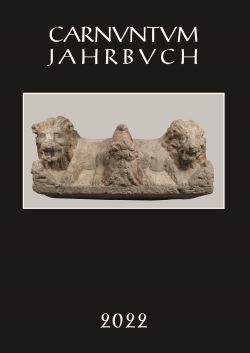
Das ‘Carnuntum Jahrbuch. Zeitschrift für Archäologie und Kulturgeschichte des Donauraumes‘ versteht sich als das wissenschaftliche Forum zur Vorlage von Grabungs-, Fund- und Forschungsberichten aus Carnuntum und seinem Einzugsgebiet. Darüber hinaus bietet die Zeitschrift die Möglichkeit zur Publikation von aktuellen Forschungen auf dem Gebiet der Archäologie und Kulturgeschichte des gesamten Donauraumes.
Den Auftakt des aktuellen Bandes (2022) bilden zwei Beiträge zum norischen Abschnitt des österreichischen Donaulimes: Die Kostenpfadanalyse aus dem Hinterland von Mautern/Favianis von J. Klammer legt eine GIS-analytische Untersuchung über Lagebeziehungen des Kastells zu benachbarten Wachtürmen vor. In einer Materialstudie besprechen B. Kainrath und E. Thysell römische Militärgürtel aus Lauriacum/Enns als regionalspezifisches Phänomen. Der Abschnitt „Ausgrabungen und Funde“ enthält heuer drei Beiträge mit Carnuntiner Schwerpunkt: N. Silnović widmet sich einem Relief mit Cautopates aus dem Umfeld des Mithraskultes, und G. Kremer stellt mit ihrem Team ein Projekt zu Farbuntersuchungen auf antiken Steindenkmälern aus Carnuntum vor, hier im Speziellen die Farbfassung eines Löwenaufsatzes. Ein siedlungsarchäologischer Beitrag zur Carnuntiner Zivilstadt von C. Gugl, S. Radbauer und E. Pollhammer führt Ergebnisse von Prospektionen und älteren Feldforschungen aus 1976 erfolgreich zusammen und erlaubt so einen weiteren Schritt zur Vervollständigung des Stadtplanes von Carnuntum.
|