![]() |
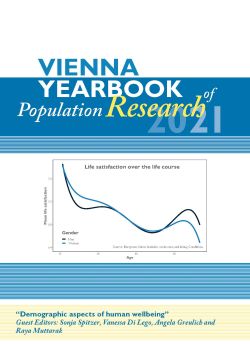
Vienna Yearbook of Population Research 2021Demographic Aspects of Human Wellbeing
|
![]() |
Verlag der Österreichischen Akademie der Wissenschaften Austrian Academy of Sciences Press
A-1011 Wien, Dr. Ignaz Seipel-Platz 2
Tel. +43-1-515 81/DW 3420, Fax +43-1-515 81/DW 3400 https://verlag.oeaw.ac.at, e-mail: verlag@oeaw.ac.at |
|
||||||||||||||||||||
|
DATUM, UNTERSCHRIFT / DATE, SIGNATURE
BANK AUSTRIA CREDITANSTALT, WIEN (IBAN AT04 1100 0006 2280 0100, BIC BKAUATWW), DEUTSCHE BANK MÜNCHEN (IBAN DE16 7007 0024 0238 8270 00, BIC DEUTDEDBMUC)
|

Vienna Yearbook of Population Research 2021, pp. 127-140, 2021/03/09
Demographic Aspects of Human Wellbeing
Per capita GDP has limited use as a well-being indicator because it does not capture many dimensions that imply a “good life”, such as health and equality of opportunity. However, per capita GDP has the virtues of being easy to interpret and to calculate with manageable data requirements. Against this backdrop, there is a need for a measure of well-being that preserves the advantages of per capita GDP, but also includes health and equality. We propose a new parsimonious indicator to fill this gap, and calculate it for 149 countries. This new indicator could be particularly useful in complementing standard well-being indicators during the COVID-19 pandemic. This is because (i) COVID-19 predominantly affects older adults beyond their prime working ages whose mortality and morbidity do not strongly affect GDP, and (ii) COVID-19 is known to have large effects on inequality in many countries.
Keywords: Beyond GDP; Well-being ; Health; Inequality; Human development; Lifetime income; COVID-19
