![]() |
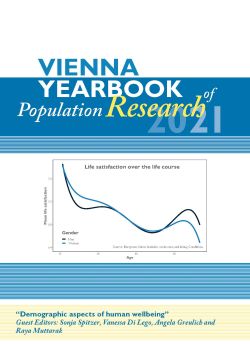
Vienna Yearbook of Population Research 2021Demographic Aspects of Human Wellbeing
|
![]() |
Verlag der Österreichischen Akademie der Wissenschaften Austrian Academy of Sciences Press
A-1011 Wien, Dr. Ignaz Seipel-Platz 2
Tel. +43-1-515 81/DW 3420, Fax +43-1-515 81/DW 3400 https://verlag.oeaw.ac.at, e-mail: verlag@oeaw.ac.at |
|
||||||||||||||||||||
|
DATUM, UNTERSCHRIFT / DATE, SIGNATURE
BANK AUSTRIA CREDITANSTALT, WIEN (IBAN AT04 1100 0006 2280 0100, BIC BKAUATWW), DEUTSCHE BANK MÜNCHEN (IBAN DE16 7007 0024 0238 8270 00, BIC DEUTDEDBMUC)
|

Vienna Yearbook of Population Research 2021, pp. 23-28, 2021/01/21
Demographic Aspects of Human Wellbeing
Demography studies the characteristics of populations. One such characteristic is well-being: this was the subject of the 2019 Wittgenstein Conference. Here, I discuss how objective well-being domains can be summarised to produce an overall wellbeing score, and how taking self-reported (subjective) well-being into account may help in this effort. But given that there is more than one type of subjective wellbeing score, we would want to know which one is “best”. We would also need to decide whose well-being counts, or counts more than that of others. Finally, I briefly mention the potential role of adaptation and social comparisons in the calculation of societal well-being.
Keywords: Subjective well-being; Demography; Measurement; Policy
