![]() |
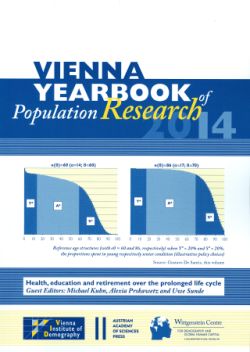
Vienna Yearbook of Population Research 2014Health, Education, and Retirement over the Prolonged Life Cycle
|
![]() |
Verlag der Österreichischen Akademie der Wissenschaften Austrian Academy of Sciences Press
A-1011 Wien, Dr. Ignaz Seipel-Platz 2
Tel. +43-1-515 81/DW 3420, Fax +43-1-515 81/DW 3400 https://verlag.oeaw.ac.at, e-mail: verlag@oeaw.ac.at |
|
||||||||||||||||||||
|
DATUM, UNTERSCHRIFT / DATE, SIGNATURE
BANK AUSTRIA CREDITANSTALT, WIEN (IBAN AT04 1100 0006 2280 0100, BIC BKAUATWW), DEUTSCHE BANK MÜNCHEN (IBAN DE16 7007 0024 0238 8270 00, BIC DEUTDEDBMUC)
|

Vienna Yearbook of Population Research 2014, pp. 169, 2000/02/21
Health, Education, and Retirement over the Prolonged Life Cycle
After exploring the rationale of pension systems, I outline the essential characteristics of ‘almost ideal pension systems’ (AIPSs), an improved version of the pay-as-you-go (PAYG) model. Depending on the policy choices, to be expressed in relative terms with parameters that range between zero and one, several—and possibly very different—forms of AIPSs can take shape: e.g. with high or low pension benefits, or with early or late retirement. (Almost) independent of the version chosen, AIPSs compare favourably in theory and in simulations to all other PAYG pension systems: for example, AIPSs are found to be superior in terms of their ability to ensure a balanced budget, intergenerational equity, resilience in the face of virtually all possible demographic and economic changes, and constancy at the preferred level for the relative economic well-being of the three basic age groups (young people, adults, and seniors). In addition, AIPSs are able to reduce, and even partly redress, the normally perverse redistributive effects that derive from heterogeneity in survival rates between subpopulation groups.
Keywords: Health; Education; Retirement; Pension System