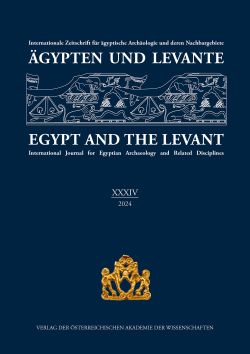
• Manfred BIETAK (Editor in Chief) - Ernst Czerny - Christiana Köhler - Nadine Moeller - Karol Myśliwiec (Eds.)

Ägypten und Levante XXXIV
Egypt and the Levant XXXIV

Internationale Zeitschrift für ägyptische Archäologie und deren Nachbargebiete
International Journal for Egyptian Archaeology and Related Disciplines

Bild

Manfred Bietak
ist emer. Professor für Ägyptologie an der Uni Wien

Die internationale und interdisziplinär ausgerichtete Zeitschrift „Ägypten und Levante“, die einmal jährlich im Druck und online erscheint, wurde im Jahr 1990 von Manfred Bietak begründet, um den Forschungen zu den Kulturkontakten zwischen Ägypten und seinen Nachbarländern eine Publikationsplattform zu bieten. Das Themenfeld der Zeitschrift umfasst Berichte zu archäologischen Grabungen in Ägypten und dem gesamten Vorderen Orient mit dem Sudan, wie auch Artikel zu allen Aspekten der ägyptischen und nahöstlichen Archäologie, Geschichts- und Kulturwissenschaft. Der Fokus liegt auf der pharaonischen Zeit, jedoch sind sowohl Beiträge zur Ur- und Frühgeschichte der genannten Regionen wie auch zur nachpharaonischen Antike möglich, ebenso zu naturwissenschaftlichen Themen. Band 34 (2024) enthält einen Vorbericht zu aktuellen Grabungen in Hala Sultan Tekke auf Zypern und in Tell Nebeshe im Ostdelta Ägyptens. Es wird die Tracht der Levantiner rekonstruiert sowie der Handel mit mittelzypriotischen Waren in der Levante analysiert. Eine lexicographische Studie hat den Begriff für Armut in Ägypten zum Gegenstand, ein Artikel die Wiederaufnahme diplomatischer Beziehungen von Ägypten und Ugarit nach der Schlacht bei Qadesch. Die numerische Terminologie in den Lahun Papyri wird vorgestellt, ebenso Nubier und Asiaten in ägyptischen Schriftquellen verglichen. Beiträge befassen sich mit organischen Relikten aus der prähistorischen Fundstelle Bargat el-Shab, mit zwei nach Ägypten importierten Ölsorten und importierten Waren aus dem eisenzeitlichen Megiddo. Es werden Tierknochenfunde aus Abusir vorgestellt und das ptolemäische Sanktuar von Deir el-Bahari im Lichte neuerer Forschungen diskutiert. In einem Essay werden kulturelle Zusammenhänge von Nubien und Ägypten behandelt. Schließlich wird die Dekoration des königlichen Kult-Komplexes in Deir el-Bahari vorgestellt. Studien zur Chronologie der 5. Dynastie anhand eines in Abu Ghurab gefundenen Siegelabdrucks des Schepseskare sowie die Analyse der Kupfer Funde aus Tell el-Retaba bilden den Abschluss des Bandes.

Verlag der Österreichischen Akademie der Wissenschaften
Austrian Academy of Sciences Press
A-1011 Wien, Dr. Ignaz Seipel-Platz 2
Tel. +43-1-515 81/DW 3420, Fax +43-1-515 81/DW 3400
https://verlag.oeaw.ac.at, e-mail: verlag@oeaw.ac.at

Egypt and the Levant was founded by Manfred Bietak in 1990 to provide a publication platform for the research on cultural contacts between Egypt and her neighbours. A focus of interest was the Egyptian-Canaanite fusion of cultures, which was mainly encountered at the site of Tell el-Dab’a during the Austrian excavations. From the beginning, the scope of the journal was international and interdisciplinary. The subject area has now been greatly expanded far beyond the original topics. It comprises reports and preliminary reports on archaeological excavations in Egypt and the entire Middle East including the Sudan, as well as articles dealing with all aspects of Egyptian and Near Eastern archaeology, history or cultural history. The main emphasis lays on the pharaonic period, but both contributions to prehistory of the said regions, and post-pharaonic periods may be accepted. In addition, a broad range of scientific topics is covered, including C14-dating, material analyses, archaeobotanical and archaeozoological studies as well as studies in physical anthropology. Egypt and the Levant is published on an annual basis, both in print and online. Submitted articles are intended to be published in a timely manner. Manuscripts may be submitted in English, German or French. Book reviews are not accepted. All submitted articles are subject to international peer-review according to quality standards of the Austrian Academy of Sciences.

Bestellung/Order


Bild
Ägypten und Levante XXXIV Egypt and the Levant XXXIV
ISSN 1015-5104
Print Edition
ISSN 1813-5145
Online Edition
ISBN 978-3-7001-9725-6
Print Edition
ISBN 978-3-7001-9726-3
Online Edition


Send or fax to your local bookseller or to:

Verlag der Österreichischen Akademie der Wissenschaften
Austrian Academy of Sciences Press
A-1011 Wien, Dr. Ignaz Seipel-Platz 2,
Tel. +43-1-515 81/DW 3420, Fax +43-1-515 81/DW 3400
https://verlag.oeaw.ac.at, e-mail: bestellung.verlag@oeaw.ac.at
UID-Nr.: ATU 16251605, FN 71839x Handelsgericht Wien, DVR: 0096385

Bitte senden Sie mir
Please send me
 
Exemplar(e) der genannten Publikation
copy(ies) of the publication overleaf


NAME


ADRESSE / ADDRESS


ORT / CITY


LAND / COUNTRY


ZAHLUNGSMETHODE / METHOD OF PAYMENT
    Visa     Euro / Master     American Express


NUMMER

Ablaufdatum / Expiry date:  

    I will send a cheque           Vorausrechnung / Send me a proforma invoice
 
DATUM, UNTERSCHRIFT / DATE, SIGNATURE

BANK AUSTRIA CREDITANSTALT, WIEN (IBAN AT04 1100 0006 2280 0100, BIC BKAUATWW), DEUTSCHE BANK MÜNCHEN (IBAN DE16 7007 0024 0238 8270 00, BIC DEUTDEDBMUC)
Bild

Analysis of a Form of Poverty in Ancient Egypt: A Lexicographical and Sociological Study of šwȝw

    Delphine Driaux

Ägypten und Levante 34, pp. 149-176, 2025/02/05

Internationale Zeitschrift für ägyptische Archäologie und deren Nachbargebiete
International Journal for Egyptian Archaeology and Related Disciplines

doi: 10.1553/AEundL34s149

doi: 10.1553/AEundL34s149

PDF
X
BibTEX-Export:

X
EndNote/Zotero-Export:

X
RIS-Export:

X 
Researchgate-Export (COinS)

Permanent QR-Code

doi:10.1553/AEundL34


doi:10.1553/AEundL34s149


doi:10.1553/AEundL34s149

Abstract

This article presents a comprehensive examination of the term šwȝw, traditionally translated as “poor man” within ancient Egyptian texts Combining both linguistic and sociological approaches, it traces the usage of šwȝw and its related verb forms from the Old Kingdom to the Graeco-Roman period. The study aims to determine whether šwȝw and similar terms reflect distinct nuances of poverty and social status. The research indicates that šwȝw signifies more than just economic deprivation; it denotes a sudden shift in social standing caused by external circumstances, setting it apart from other terms that convey different aspects of inferiority and dependency. Furthermore, the article explores societal responses to šwȝw, which reveal broader cultural attitudes, including both the provision of assistance and the marginalisation of this group. It concludes that a nuanced understanding of šwȝw and its variations offers valuable insights into the social hierarchy and conceptualisations of poverty in ancient Egypt, demonstrating it to be a complex and multi-dimensional issue.

Keywords: Šwȝw, Poverty, Ancient Egypt, Lexicography, Social status, Deprivation, Sociological analysis, Social hierarchy.