
![]() |
Österreichische Zeitschrift für Kunst und Denkmalpflege
|
![]() |
Die „Österreichische Zeitschrift für Kunst und Denkmalpflege“, ÖZKD, geht auf die „Mittheilungen der k. k. Central-Commission zur Erforschung und Erhaltung der Baudenkmale“, Band I erschienen 1856, zurück und wird in der heutigen Form seit 1952 publiziert. Der Schwerpunkt liegt auf den Themen Bauforschung, denkmaltheoretischen Beiträgen und architekturhistorischen Forschungen in Österreich und Europa. Einzelne Ausgaben erläutern die Restaurierung von Denkmalen im restauratorischen Kontext oder berichten über die Ergebnisse von Tagungen und Fachgesprächen. Die ÖZKD gibt damit den aktuellen Diskussions- und Forschungsstand in den Bereichen Denkmalschutz und Denkmalpflege wieder.
|

![]() |
Verlag der Österreichischen Akademie der Wissenschaften Austrian Academy of Sciences Press
A-1011 Wien, Dr. Ignaz Seipel-Platz 2
Tel. +43-1-515 81/DW 3420, Fax +43-1-515 81/DW 3400 https://verlag.oeaw.ac.at, e-mail: verlag@oeaw.ac.at |
|
||||||||||||||||||||
|
DATUM, UNTERSCHRIFT / DATE, SIGNATURE
BANK AUSTRIA CREDITANSTALT, WIEN (IBAN AT04 1100 0006 2280 0100, BIC BKAUATWW), DEUTSCHE BANK MÜNCHEN (IBAN DE16 7007 0024 0238 8270 00, BIC DEUTDEDBMUC)
|

ÖZKD LXXVIII 2024 Heft 4, pp. 86-102, 2025/02/12
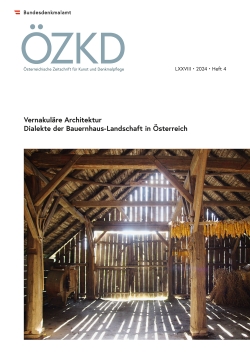
Vernakuläre Architektur
Dialekte der Bauernhaus-Landschaft in Österreich
Given the profound structural transformation in rural areas since the late 19th century, as well as current trends, the question of identity of these areas arises. This contribution presents the results of house research and its practical application, which have been advanced through European recommendations and conventions. In this context, only the most significant documents of the European regulatory framework can be highlighted. The issue requires a specific and current selection of methodological approaches for identifying cultural landscapes, inventorying them, and integrating cultural landscape elements into modern cultural landscape development. Subject and components of the systematic and comprehensive approach include, first and foremost, the preparation of data provided by various stakeholders across different planning levels. The final step involves the presentation of a descriptive framework or matrix applicable to all house landscapes, and thus to rural cultural heritage, using a spatial reference system with cultural landscape regions or cultural landscape units of Upper Austria (Herbert Maurer). This enables the integration of cultural heritage into the broader context of social development, spatial planning, and environmental policy.