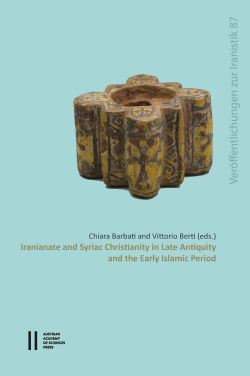
• Chiara Barbati - Vittorio Berti (eds.)

Iranianate and Syriac Christianity in Late Antiquity and Early Islamic Period

Bild

Chiara  Barbati
is Senior Researcher at the University of Pisa

Vittorio Berti
is Associate Professor of History of Christianity at the University of Padua


It is by now widely acknowledged that between late antiquity and the first centuries of Islam, Syriac-speaking Christian communities were more than just scattered minority communities with little impact in geographical areas strongly shaped by the Iranian element. “Iranianate and Syriac Christianity” bridges across different specialized disciplines, first and foremost Iranian Studies and Syriac Studies and the History of Christianity, and assembles a range of authoritative voices on the subject. The 14 contributions are arranged in two sections: Mission, Conversion and Power and Languages, Texts and Concepts, representing a wide range of approaches and reflecting the complexity of the religious, political and cultural history of the Christian communities in the Eurasian area up to the year 1000 and beyond.

…

Verlag der Österreichischen Akademie der Wissenschaften
Austrian Academy of Sciences Press
A-1011 Wien, Dr. Ignaz Seipel-Platz 2
Tel. +43-1-515 81/DW 3420, Fax +43-1-515 81/DW 3400
https://verlag.oeaw.ac.at, e-mail: verlag@oeaw.ac.at

Es besteht inzwischen weithin Konsens, dass die syrischsprachigen, christlichen Gemeinschaften in der Spätantike und den ersten Jahrhunderten des Islam mehr waren als nur verstreute Minderheitengemeinschaften, die in geografischen Gebieten, die stark vom iranischen Element geprägt waren, nur geringen Einfluss gehabt hätten. „Iranianate and Syriac Christianity“ schlägt eine Brücke zwischen verschiedenen Fachdisziplinen, vor allem der Iranistik, der Syriazistik und der Geschichte des Christentums, und versammelt eine Reihe maßgeblicher Stimmen zu diesem Thema. Die 14 Beiträge sind in zwei Abschnitte gegliedert: Mission, Bekehrung und Macht sowie Sprachen, Texte und Konzepte. Sie repräsentieren ein breites Spektrum von Ansätzen und spiegeln die Komplexität der religiösen, politischen und kulturellen Geschichte der christlichen Gemeinschaften im eurasischen Raum bis zum Jahr 1000 und darüber hinaus wider.

Bestellung/Order


Bild
Iranianate and Syriac Christianity in Late Antiquity and Early Islamic Period


ISBN 978-3-7001-9006-6
Print Edition
ISBN 978-3-7001-9022-6
Online Edition



Send or fax to your local bookseller or to:

Verlag der Österreichischen Akademie der Wissenschaften
Austrian Academy of Sciences Press
A-1011 Wien, Dr. Ignaz Seipel-Platz 2,
Tel. +43-1-515 81/DW 3420, Fax +43-1-515 81/DW 3400
https://verlag.oeaw.ac.at, e-mail: bestellung.verlag@oeaw.ac.at
UID-Nr.: ATU 16251605, FN 71839x Handelsgericht Wien, DVR: 0096385

Bitte senden Sie mir
Please send me
 
Exemplar(e) der genannten Publikation
copy(ies) of the publication overleaf


NAME


ADRESSE / ADDRESS


ORT / CITY


LAND / COUNTRY


ZAHLUNGSMETHODE / METHOD OF PAYMENT
    Visa     Euro / Master     American Express


NUMMER

Ablaufdatum / Expiry date:  

    I will send a cheque           Vorausrechnung / Send me a proforma invoice
 
DATUM, UNTERSCHRIFT / DATE, SIGNATURE

BANK AUSTRIA CREDITANSTALT, WIEN (IBAN AT04 1100 0006 2280 0100, BIC BKAUATWW), DEUTSCHE BANK MÜNCHEN (IBAN DE16 7007 0024 0238 8270 00, BIC DEUTDEDBMUC)
Bild

The Syriac and Sogdian Prefaces to the Six Books on the Dormition of the Virgin Mary. Marian Traditions between the Eastern Mediterranean and Central Asia

    Adrian C. Pirtea

Iranianate and Syriac Christianity in Late Antiquity and Early Islamic Period, pp. 279-332, 2021/12/21

€  80 

incl. VAT
PDF
X
BibTEX-Export:

X
EndNote/Zotero-Export:

X
RIS-Export:

X 
Researchgate-Export (COinS)

Permanent QR-Code

Abstract

A fragmentary Christian Sogdian version of the Six Books on the Dormition of Mary from Turfan has recently come to light, but the place of this narrative within the larger context of Eastern Christian Marian literature has not yet been studied in detail. One distinguishing trait of the Sogdian fragment is the topographic shift in the discovery story which prefaces most versions of the Six Books. Whereas according to the Syriac, Arabic and Ethiopic versions two monks from Sinai discover the “Book of Mary” at the tomb of St. John in Ephesus, the Sogdian text uniquely locates the book in the city of Constantinople. To explain this consequential change, this chapter will first reconstruct the historical and theological context of the earliest Syriac manuscripts containing the preface. These manuscripts date to the early 6th century and probably originate in an anti-Chalcedonian milieu in northern Syria. It will then be argued that the original Syriac version underwent a Melkite Syriac reworking in ca. 8th-century Syria or Palestine that involved a turn towards the Byzantine capital as the new symbolic center of Christian devotion to Mary. The last part of the study will discuss how this (now lost) Melkite Syriac narrative may have reached the Christian communities of Central Asia where it was translated into Sogdian.