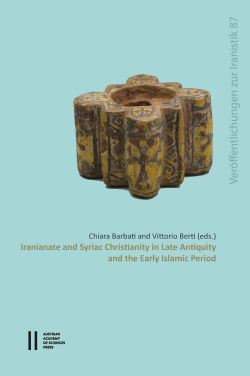
Es besteht inzwischen weithin Konsens, dass die syrischsprachigen, christlichen Gemeinschaften in der Spätantike und den ersten Jahrhunderten des Islam mehr waren als nur verstreute Minderheitengemeinschaften, die in geografischen Gebieten, die stark vom iranischen Element geprägt waren, nur geringen Einfluss gehabt hätten. „Iranianate and Syriac Christianity“ schlägt eine Brücke zwischen verschiedenen Fachdisziplinen, vor allem der Iranistik, der Syriazistik und der Geschichte des Christentums, und versammelt eine Reihe maßgeblicher Stimmen zu diesem Thema. Die 14 Beiträge sind in zwei Abschnitte gegliedert: Mission, Bekehrung und Macht sowie Sprachen, Texte und Konzepte. Sie repräsentieren ein breites Spektrum von Ansätzen und spiegeln die Komplexität der religiösen, politischen und kulturellen Geschichte der christlichen Gemeinschaften im eurasischen Raum bis zum Jahr 1000 und darüber hinaus wider.
|
Iranianate and Syriac Christianity in Late Antiquity and Early Islamic Period
ISBN 978-3-7001-9006-6
Print Edition
ISBN 978-3-7001-9022-6
Online Edition

|
Send or fax to your local bookseller or to:
Verlag der Österreichischen Akademie der Wissenschaften
Austrian Academy of Sciences Press
A-1011 Wien, Dr. Ignaz Seipel-Platz 2,
Tel. +43-1-515 81/DW 3420, Fax +43-1-515 81/DW 3400
https://verlag.oeaw.ac.at, e-mail: bestellung.verlag@oeaw.ac.at
UID-Nr.: ATU 16251605, FN 71839x Handelsgericht Wien, DVR: 0096385
Bitte senden Sie mir
Please send me |
|
Exemplar(e) der genannten Publikation
copy(ies) of the publication overleaf |
NAME
|
ADRESSE / ADDRESS
|
ORT / CITY
|
LAND / COUNTRY
ZAHLUNGSMETHODE / METHOD OF PAYMENT
Visa Euro / Master American Express
|
NUMMER
|
Ablaufdatum / Expiry date:
I will send a cheque
Vorausrechnung / Send me a proforma invoice
|
|