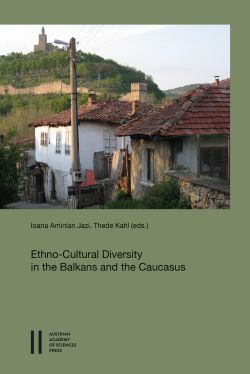
• Ioana Aminian Jazi - Thede Kahl (eds)

Ethno-Cultural Diversity
in the Balkans and the Caucasus

Bild

Ioana Aminian Jazi
is a PhD candidate in Linguistics at the University of Vienna

Thede Kahl
is Professor of South Slavic and Southeast European Studies at the Friedrich Schiller University Jena.


This book brings together studies from a variety of different fields in an attempt to illuminate current multidisciplinary comparative research on ethno-cultural diversity in the Balkan and the Caucasus regions. The articles cover a wide variety of topics and include studies mapping the ethnic identity, archaeology and linguistics of these two very diverse geographical areas. Particular attention is paid to aspects of ethnic identity, migration and contact between the different ethnic groups and to parallel processes resulting from the interactions between minorities and majorities in the two cultural regions. Comprehensive research dealing with the transformations of everyday culture (music, theatre, material culture) and social changes (the ratio of men to women, gender studies, socialist feminist politics, a return to patriarchal societies) has been scarce for these regions, since the focus of research was previously directed to more specific topics. The present volume aims to bridge this gap, in order to contribute to a better understanding of similarities, differences, and transformations that characterize these areas, and to encourage further in-depth comparative research.

Verlag der Österreichischen Akademie der Wissenschaften
Austrian Academy of Sciences Press
A-1011 Wien, Dr. Ignaz Seipel-Platz 2
Tel. +43-1-515 81/DW 3420, Fax +43-1-515 81/DW 3400
https://verlag.oeaw.ac.at, e-mail: verlag@oeaw.ac.at

Internationale Experten verschiedener Disziplinen diskutieren in diesem Buch die ethno-kulturelle Vielfalt auf dem Balkan und im Kaukasus. Die Beiträge reichen von der ethnischen Kartographie über archäologische Einblicke bis hin zu sprachwissenschaftlichen Fragestellungen der beiden ethnisch, sprachlich und kulturell sehr vielfältigen Areale. Ein besonderer Fokus liegt auf Aspekten der ethnischen Identität und Migration sowie des Kontakts zwischen den verschiedenen ethnischen Gruppen, vor allem zwischen Minderheiten und Mehrheiten, die die beiden untersuchten Kulturräume bewohnen. Im Zentrum stehen dabei die Diskussionen über den Einfluss der ethno-kulturellen Vielfalt auf die sozialen und politischen Realitäten auf dem Balkan und im Kaukasus. Die multidisziplinären Fallstudien betrachten parallele Prozesse auf zwei gegenüberliegenden Seiten des Schwarzen Meeres. Umfassende Forschungen, die sich mit Transformationen der Alltagskultur (Musik, Theater, materielle Kultur) und gesellschaftlichen Veränderungen (Gender Studies, sozialistische feministische Politik, Rückkehr zu patriarchalen Gesellschaften) auseinandersetzen, sind ausgesprochen rar und konzentrieren sich zumeist auf einzelne Phänomene. Der vorliegende Band möchte diese Lücke schließen, zu einem besseren Verständnis einiger Gemeinsamkeiten und Unterschiede dieser Kulturräume und der laufenden Transformationen beitragen sowie zu weiterführender vergleichender Forschung einladen.

Bestellung/Order


Bild
Ethno-Cultural Diversityin the Balkans and the Caucasus


ISBN 978-3-7001-8875-9
Print Edition
ISBN 978-3-7001-9345-6
Online Edition


Send or fax to your local bookseller or to:

Verlag der Österreichischen Akademie der Wissenschaften
Austrian Academy of Sciences Press
A-1011 Wien, Dr. Ignaz Seipel-Platz 2,
Tel. +43-1-515 81/DW 3420, Fax +43-1-515 81/DW 3400
https://verlag.oeaw.ac.at, e-mail: bestellung.verlag@oeaw.ac.at
UID-Nr.: ATU 16251605, FN 71839x Handelsgericht Wien, DVR: 0096385

Bitte senden Sie mir
Please send me
 
Exemplar(e) der genannten Publikation
copy(ies) of the publication overleaf


NAME


ADRESSE / ADDRESS


ORT / CITY


LAND / COUNTRY


ZAHLUNGSMETHODE / METHOD OF PAYMENT
    Visa     Euro / Master     American Express


NUMMER

Ablaufdatum / Expiry date:  

    I will send a cheque           Vorausrechnung / Send me a proforma invoice
 
DATUM, UNTERSCHRIFT / DATE, SIGNATURE

BANK AUSTRIA CREDITANSTALT, WIEN (IBAN AT04 1100 0006 2280 0100, BIC BKAUATWW), DEUTSCHE BANK MÜNCHEN (IBAN DE16 7007 0024 0238 8270 00, BIC DEUTDEDBMUC)
Bild

The Bosniaks in Turkey Between Assimilation and Ethnic Revival: Social and Political Issues Since the Migration to the Present Day

    Christoph Giesel

Ethnocultural Diversity in the Balkans and the Caucasus, pp. 105-142, 2023/02/09

€  69,00 

incl. VAT
PDF
X
BibTEX-Export:

X
EndNote/Zotero-Export:

X
RIS-Export:

X 
Researchgate-Export (COinS)

Permanent QR-Code

Abstract

In the almost 100 years between 1878 and 1970, a large number of Bosniaks emigrated in several waves to the Ottoman Empire and Turkey from the territories of what are today known as Bosnia, Serbia, Montenegro, Kosovo and North Macedonia. Estimates regarding the number of Turkish citizens of Bosniak heritage range between 3 and 5 million, but the number of Shtokavian resp. Bosnian or “Bosniak” speakers encompasses considerably fewer, with estimates between a few dozen thousand to a maximum of several hundred thousand. Despite the rigid assimilation policies pursued by the Turkish state in the 20th century, they succeeded in retaining certain forms of their “Yugoslav- Muslim” or “Bosniak” ethnicity within the context of their social and linguistic embeddedness in Turkey where they are subject to a mixture of Turkish assimilation and ethnic revival processes. This is why this community displays numerous and multi-faceted aspects of identity, social, linguistic and ethnic attitudes as well as collective memories. After introductory remarks about controversies regarding the origin and language of the Bosniaks in Ex-Yugoslavia and Turkey as well as about the distribution, number and developments of the Bosniak settlement structure in Turkey, this paper investigates the history of and reasons for migration as well as the historical and contemporary aspects of ethnicity, nationality, identity, integration, assimilation, social experiences, situation and status, ethno-cultural life and selected trends of political attitudes of the Bosniaks in Turkey. Additionally, the paper regularly makes comparative references to the ethnic group of Muslim Georgians in Turkey, which shows many similarities to the Bosniaks (and other ethnically non-Turkish groups with a Sunni background) there.

Keywords: Migration, Assimilation, Ethnic Revival, Identity, Ethnic Groups, Balkan, Ottoman History