|
 |
Contents:
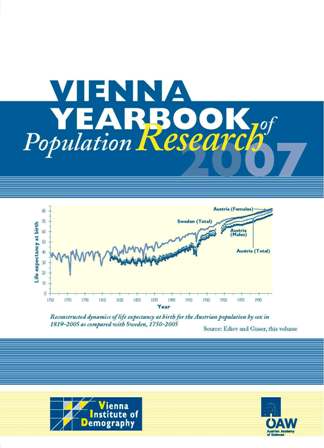
Introduction by Commissioner Vladimír Špidla to the four essays written in response to the communication on The Demographic Future of Europe; David A. COLEMAN: Demographic diversity and the ethnic consequences of immigration – key issues that the Commission's report left out; Jonathan GRANT and Stijn HOORENS: Does the Commission's report adequately address the key issues of the demographic future of Europe?; Wolfgang LUTZ: Adaptation versus mitigation policies on demographic change in Europe; Paul DEMENY: A clouded view of Europe's demographic future; Wolfgang LUTZ, Sergei SCHERBOV, Gui Ying CAO, Qiang REN and Xiaoying ZHENG: China's uncertain demographic present and future; Jeroen SPIJKER, Frans VAN POPPEL, Leo VAN WISSEN: Explaining new trends in the gender gap of mortality: Insights from a regional trend-analysis from the Netherlands; Franz SCHWARZ: Widening educational disparities in all-cause mortality: An analysis of Austrian data with international comparisons; Gustav FEICHTINGER, Maria WINKLER-DWORAK, Inga FREUND, Alexia PRSKAWETZ and Fernando RIOSMENA: On the age dynamics of learned societies – taking example of the Austrian Academy of Sciences; Dominik GRAFENHOFER, Christian JAAG, Christian KEUSCHNIGG and Mirela KEUSCHNIGG: Economic aging and demographic change; Diana HUMMEL and Alexandra LUX: Population decline and infrastructure: The case of the German water supply system; Wolfgang LUTZ, Anne GOUJON, Samir K.C. and Warren SANDERSON: Reconstruction of population by age, sex and level of educational attainment of 120 countries for 1970–2000; Anne GOUJON, Vegard SKIRBEKK, Katrin FLIEGENSCHNEE and Pavel STRZELECKI: New times, old believes: projecting the future size of religion in Austria; Dimiter PHILIPOV and Caroline BERGHAMMER: Religion and fertility ideals, intentions and behaviour: a comparative study of European countries; Isabella BUBER: Ageing in Austria: An overview of "Survey of Health, Ageing and Retirement in Europe" (SHARE) with special focus on aspects of health; Dalkhat EDIEV and Richard GISSER: Reconstruction of the historical series of life tables and of age-sex structures for the Austrian population in 19th-first half of 20th centuries; Maria Rita TESTA: Childbearing preferences and family issues in Europe: evidence from the Eurobarometer 2006 survey
|